Ask five neighbors standing on the Isleworth floating docks which lake their boat just left, and you'll get three different answers, and the correct one still surprises most of them. It isn't Lake Isleworth. The community's actual water access sits on the north end of Lake Tibet, a lake most people outside the gates have never heard named, let alone learned to spell. The small circular lake that carries the neighborhood's name is real, but it's a stop two canals away, not the launch point.
This isn't trivia for a bar bet. It changes how a normal Saturday on the Butler Chain actually unfolds, what's genuinely close versus what only looks close on a map, and why the best water for skiing might already be under your own dock instead of a destination you have to plan for.
The Namesake Lake Isn't the Launch Point
Lake Isleworth is small, about 86 acres, and it's the only community that fronts it. That last part sounds like a private amenity, and in one sense it is. But it's also the lake where the public's front door to the entire 13-lake system sits: R.D. Keene Park's boat ramp, one of only two public launch points on the whole chain, opens directly onto Lake Isleworth. So the lake carrying the neighborhood's name is shared, on any given weekend, with every trailer that pulls off Chase Road looking for open water.
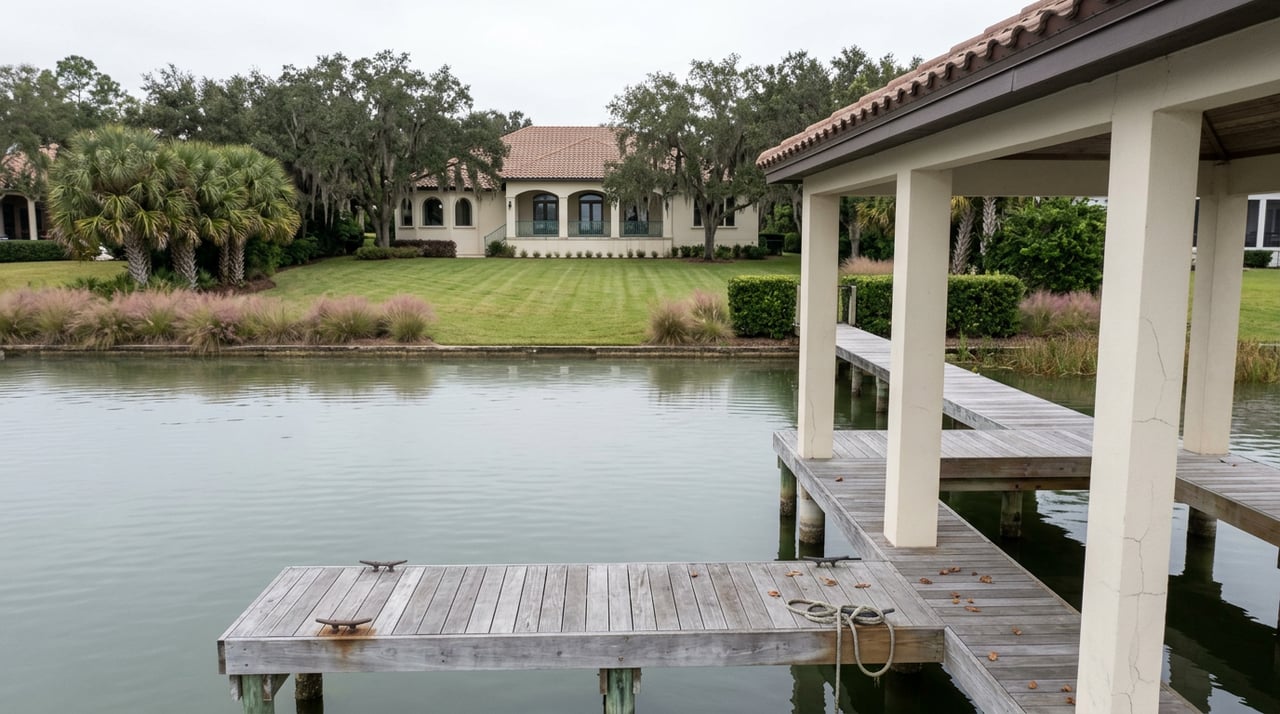
Meanwhile the club's own floating docks, the ones most residents actually use, sit on Lake Tibet, well north of the public ramp and connected to Lake Isleworth only by a narrow canal running south through Lake Louise. If your mental map has you launching from "your" lake, you're actually one canal removed from it, and that gap is the whole point of this piece.
What's Really Under Your Dock
Lake Tibet, more formally Lake Tibet-Butler, is the second-largest lake in the chain at roughly 1,200 acres, trailing only Lake Butler itself at about 1,600 acres. It's also one of the better lakes in the system for actual water sports, and it hosts one of the chain's few permanent slalom ski courses, a fixture that's rare anywhere in Central Florida. Isleworth's floating docks sit right at the seam where Tibet meets Lake Chase, which means the good ski water isn't a destination you plan a trip around. It's a two-minute idle from your slip.
That's the part worth sitting with. A lot of Butler Chain marketing leans on the name "Isleworth," but the lake doing the heavy lifting for the community's water lifestyle is Tibet, not Isleworth. Here's how the lakes actually thread together around the community, based on acreage recorded by the University of South Florida's Water Institute:
| Lake | Approx. acreage | What it's known for |
|---|---|---|
| Lake Tibet-Butler | 1,200 | Second-largest in the chain; permanent slalom ski course; Isleworth's actual community access |
| Lake Butler | 1,600 | Largest lake; home to Bird Island, the chain's weekend social hub |
| Lake Chase | 135 | Fronted by Isleworth, Isle of Osprey, and part of Bay Hill; good bass structure |
| Lake Blanche | 121 | Fronted by Isleworth, Isle of Osprey, and North Bay; quieter, more residential frontage |
| Lake Isleworth | 86 | Carries the community's name; site of the public R.D. Keene Park ramp |
Notice that the lake with the most surface area and the ski course, Tibet, isn't the one everyone assumes is central. It just happens to be the one closest to where the docks actually sit.
Three Slow Zones Before Bird Island
Lake Butler is home to Bird Island, a roughly 23-acre sanctuary owned by the Florida Audubon Society where boaters gather and anchor on weekend afternoons, particularly on the north side. It's the closest thing the chain has to a social headquarters. For an Isleworth resident, though, reaching it isn't a straight shot. The path runs from Lake Tibet through the connecting canal, briefly touching Lake Louise, before opening into Lake Butler itself.
Every one of those canal connections is idle-speed water. All of the canals linking the chain's lakes are marked no-wake zones, and the narrow passages between lakes are exactly the kind of tight, low-visibility water where that rule gets enforced most consistently. A trip that looks like a few hundred yards on a map can take longer than the open-water cruise on either end of it, simply because you're creeping through connector canals for a meaningful chunk of the ride. If you're timing an afternoon around getting to Bird Island before the good anchoring spots fill up, budget the canal time separately from the lake time. They're not the same kind of minute.
The Ramp at Your Gate Isn't Really Yours
Here's the part that catches longtime residents off guard more than newcomers. R.D. Keene Park's ramp, sitting right on Lake Isleworth, is one of exactly two public launch points for the entire Butler Chain, the other being the free ramp on Lake Down across Conroy-Windermere Road from Isleworth's main entrance. That means two of the busiest public access points on a system connecting thirteen lakes both sit within a few minutes of Isleworth's gates.
On a summer Saturday, that translates to trailer traffic queuing near a lake that carries the community's name, even though it isn't where most residents keep their boats. It's a small irony worth knowing: the public's easiest way onto "the chain" and the private community's most visible landmark happen to be the same small lake, for reasons that have more to do with geography than branding.
The practical takeaway is timing. If you're headed out for open water on Tibet or Butler, an early start beats the ramp crowd building at Keene Park, and it beats the afternoon heat that tends to bring boat traffic to its peak on the bigger lakes.
Why the Chain Behaves Like a Managed System, Not Just a Lake
None of this is casual water. In 1985, the Butler Chain became the first lake system in Florida to earn the state's Outstanding Florida Waters designation, a status that comes with tighter shoreline and water-quality standards than most Central Florida lakes carry. Three years later, in 1988, the chain got its own multi-agency enforcement unit, informally known as the Butler Patrol, drawing officers from the Florida Fish and Wildlife Conservation Commission, Florida Park Patrol, and the Orange County Sheriff's Office.
That combination, a protected designation plus dedicated patrol presence, is part of why the chain still runs clear and skiable while plenty of other Central Florida lakes have degraded. It also means the rules residents live with, the idle-speed canals, the no-wake buffers, the seasonal caution around algae during hot, low-circulation stretches of late summer, aren't arbitrary inconveniences. They're the maintenance cost of water quality good enough to justify a permanent slalom course two lakes deep in a gated community.
For anyone who bought into Isleworth expecting a single private lake, the truth is better than that. You got access to a managed, protected, 13-lake system, with the best ski water sitting closer to your own dock than the map first suggests, and the shared public ramp on your namesake lake as the one reminder that the chain, however exclusive parts of it feel, is still a shared piece of Florida water.
Know which lake you're actually on, and the rest of a weekend on the Butler Chain starts making a lot more sense.
If you're weighing a move within Isleworth, comparing it to another Butler Chain address, or just want a local read on how a specific dock or lot actually sits on the chain, The Landruá Group knows this water as well as the streets around it. Let's Connect.